Description
Ultrasonic Level Transmitter
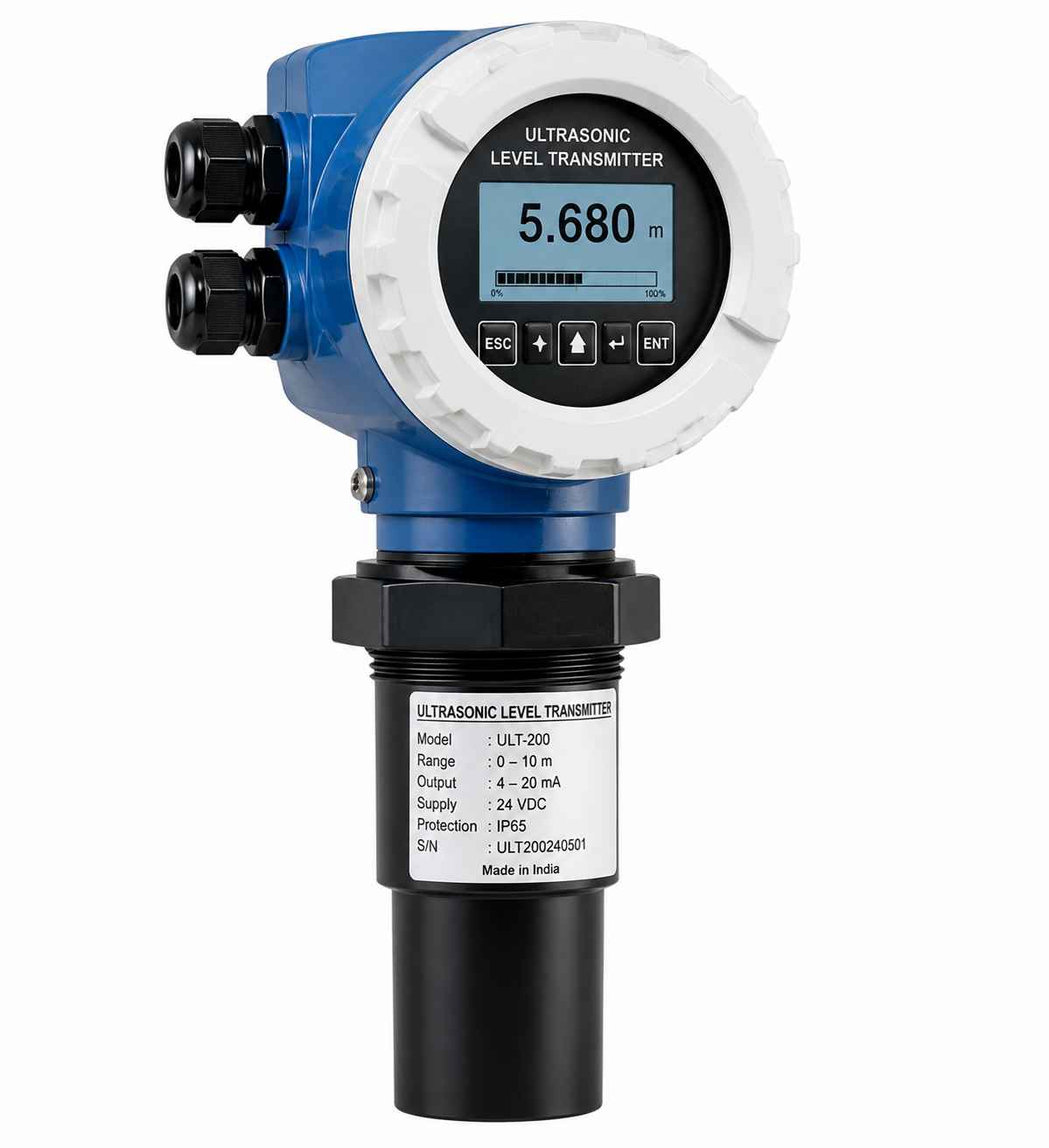
The Ultrasonic Level Transmitter is a non-contact level measurement instrument designed for continuous and accurate measurement of liquids and bulk solids in tanks, vessels, silos, and process containers. It uses ultrasonic technology to determine the level of the material without direct contact with the process medium, making it particularly suitable for applications involving corrosive, contaminated, or chemically aggressive materials.
The transmitter emits high-frequency ultrasonic pulses toward the surface of the material. These pulses are reflected back to the sensor, and the instrument calculates the distance based on the time taken for the echo to return. The measured distance is then converted into a level value and provided through the transmitter’s display and output signal.
With a non-contact design, the Ultrasonic Level Transmitter offers reliable operation with minimal maintenance and no mechanical components inside the tank. It can be integrated with PLC, DCS, SCADA, and industrial control systems for continuous process monitoring and automation.
Key Features
- Non-contact level measurement
- Continuous level monitoring
- Ultrasonic measurement technology
- No moving parts
- Low maintenance requirement
- Suitable for corrosive and contaminated liquids
- Digital display options
- 4–20 mA output available
- Optional HART / digital communication
- Easy integration with PLC, DCS and SCADA
- Adjustable measuring range
- Compact and rugged construction
- Reliable operation in industrial environments
- Suitable for tanks, vessels and silos
Working Principle
The Ultrasonic Level Transmitter sends high-frequency sound waves toward the surface of the measured material. When the ultrasonic pulse reaches the material surface, a portion of the signal is reflected back toward the transmitter.
The electronics measure the time of flight between transmission and reception of the echo. Since the speed of sound is known, the transmitter calculates the distance between the sensor and the material surface.
The measured distance is then converted into the actual level of the tank or vessel.
Ultrasonic Pulse → Material Surface → Echo Return → Signal Processing → Level Measurement
Because the sensor does not come into direct contact with the process medium, it can be used for many applications where contact-type instruments may be difficult to install or maintain.
Technical Specifications
| Parameter | Specification |
|---|---|
| Product Type | Ultrasonic Level Transmitter |
| Measuring Principle | Ultrasonic / Time-of-Flight |
| Measurement Type | Non-Contact Continuous Level |
| Measuring Medium | Liquids / Bulk Solids |
| Measurement Range | Model Dependent |
| Accuracy | Model Dependent |
| Output Signal | 4–20 mA |
| Communication | HART / Digital, Model Dependent |
| Display | LCD / Digital Display, Optional |
| Sensor Material | Model Dependent |
| Process Connection | Threaded / Flanged |
| Power Supply | Model Dependent |
| Beam Angle | Model Dependent |
| Process Temperature | Model Dependent |
| Operating Pressure | Model Dependent |
| Protection Rating | Model Dependent |
| Installation | Tank / Vessel / Silo |
| Application | Industrial Level Measurement |
Applications
The Ultrasonic Level Transmitter is suitable for a wide range of industrial applications, including:
- Water & Wastewater Treatment
- Chemical Storage Tanks
- Effluent Treatment Plants
- Pharmaceutical Industries
- Food & Beverage Industries
- Oil & Gas Applications
- Industrial Storage Tanks
- Process Vessels
- Sumps and Open Channels
- Chemical Liquid Storage
- Bulk Material Silos
- Process Automation Systems
Advantages
The main advantage of ultrasonic level measurement is its non-contact operation. Since the sensor does not need to touch the process material, there is less risk of mechanical wear, contamination, or damage caused by corrosive liquids.
It is also a flexible solution for applications where installing a probe or other immersed sensor may be difficult. The transmitter can provide continuous level information and transmit the measured value to an industrial control system.
Its digital configuration and standard industrial outputs make it suitable for integration into modern process automation systems.
Installation & Operation
The Ultrasonic Level Transmitter should be installed at a suitable position above the material surface, following the manufacturer’s recommended mounting requirements. The sensor should have a clear measurement path to the surface and should be positioned away from obstructions, internal tank structures, excessive turbulence, or other sources of unwanted echoes.
For accurate operation, the transmitter should be selected according to the tank height, measuring range, material characteristics, temperature, pressure, vapour conditions, and required accuracy.
Industries Served
Water Treatment | Chemical | Pharmaceutical | Food & Beverage | Oil & Gas | Power | Manufacturing | Process Automation | Wastewater Treatment
Product Note
Exact specifications such as measurement range, accuracy, frequency, beam angle, temperature range, pressure rating, process connection, power supply, and communication protocol vary according to the selected Ultrasonic Level Transmitter model. Refer to the relevant product datasheet for final technical specifications.
Reviews
There are no reviews yet.