Description
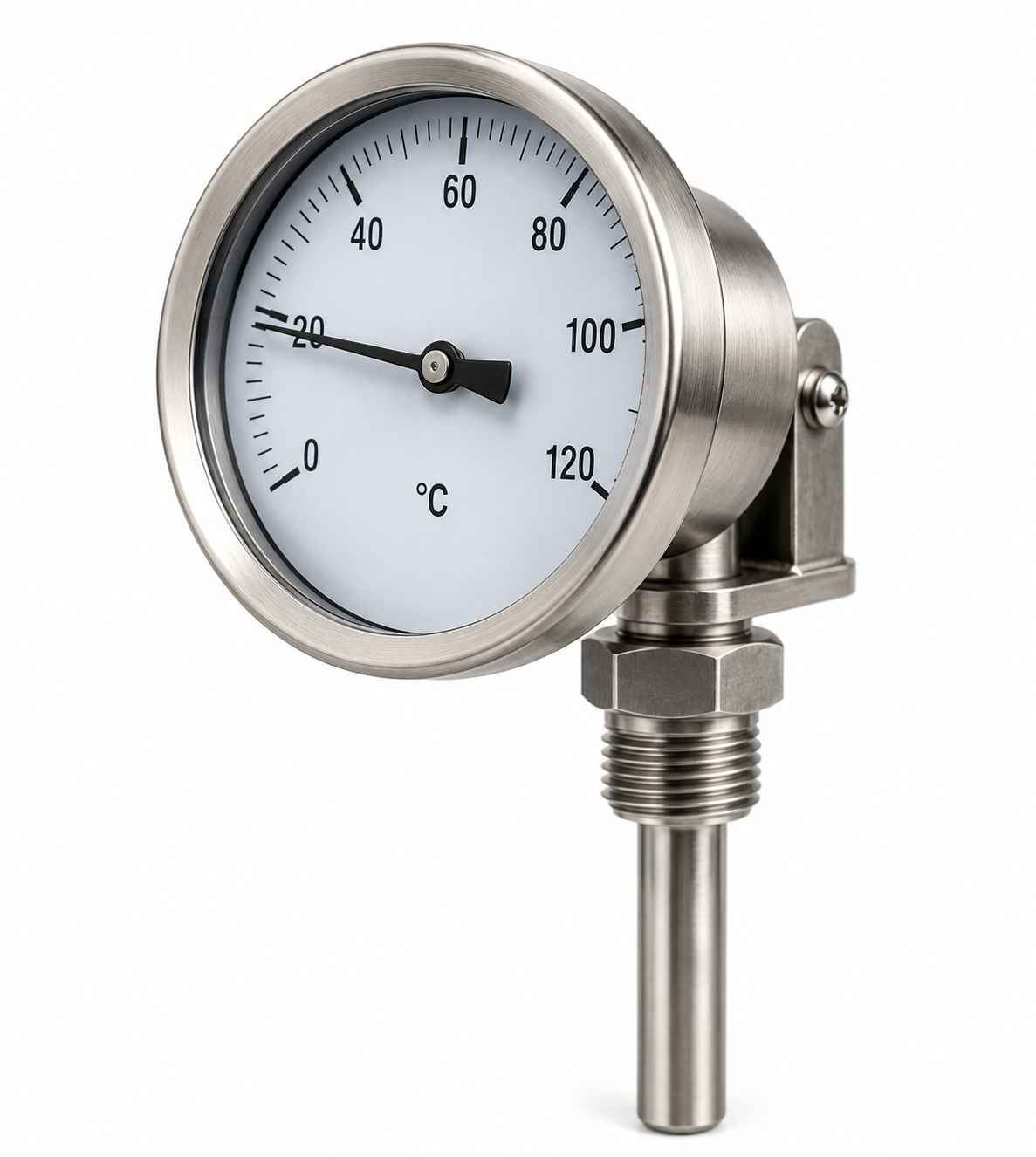
Bimetallic Thermometer
The Bimetallic Thermometer is a robust and reliable mechanical temperature measuring instrument designed for direct and continuous measurement of temperature in industrial processes, machinery, pipelines, tanks, and other process equipment. It operates without requiring an external power supply, making it a simple and dependable solution for local temperature indication.
The thermometer uses a bimetallic sensing element made from two dissimilar metals with different coefficients of thermal expansion. When the temperature changes, the metals expand or contract at different rates, causing the sensing element to deform or rotate. This mechanical movement is transferred to the pointer mechanism, which indicates the corresponding temperature on the graduated dial.
Its rugged construction and simple operating principle make the Bimetallic Thermometer suitable for applications where reliable local temperature indication is required. It can be supplied with different stem lengths, dial sizes, process connections, and materials to meet specific installation requirements.
Key Features
- Reliable mechanical temperature measurement
- No external power supply required
- Simple and rugged construction
- Easy-to-read analog dial
- Direct local temperature indication
- Good measurement stability
- Suitable for continuous operation
- Stainless steel construction options
- Multiple stem lengths available
- Various process connection options
- Adjustable viewing angle options
- Suitable for demanding industrial environments
- Low maintenance requirement
- Long service life
Working Principle
The Bimetallic Thermometer works using the different thermal expansion characteristics of two dissimilar metals.
The metals are bonded together to form a bimetallic element. When exposed to a change in temperature, one metal expands or contracts more than the other. This causes the bimetallic element to bend or rotate.
The resulting mechanical movement is transferred through the thermometer’s internal mechanism to the pointer. The pointer moves across the calibrated dial and provides a direct indication of the process temperature.
Because the instrument operates mechanically, it does not require an electrical power supply for basic temperature indication.
Technical Specifications
| Parameter | Specification |
|---|---|
| Product Type | Bimetallic Thermometer |
| Measuring Principle | Bimetallic Mechanical Expansion |
| Measurement Type | Local Temperature Indication |
| Temperature Range | Model Dependent |
| Dial Size | Model Dependent |
| Accuracy | Model Dependent |
| Stem Material | SS304 / SS316 / Other Options |
| Stem Length | Application Dependent |
| Process Connection | Threaded / Flanged / Model Dependent |
| Dial Material | Aluminium / Stainless Steel |
| Window | Glass / Toughened Glass / Acrylic |
| Pointer | Aluminium / Stainless Steel |
| Mounting | Bottom / Back / Adjustable Angle |
| Case Material | Stainless Steel / Other Options |
| Protection Rating | Model Dependent |
| Power Supply | Not Required |
| Application | Industrial Temperature Measurement |
Applications
Bimetallic Thermometers are widely used in:
- Industrial Pipelines
- Process Plants
- Chemical Industries
- Pharmaceutical Industries
- Food & Beverage Industries
- Water Treatment Plants
- HVAC Systems
- Boilers
- Heat Exchangers
- Pumps & Compressors
- Storage Tanks
- Industrial Machinery
- Power Plants
- Oil & Gas Applications
Advantages
The primary advantage of a Bimetallic Thermometer is its simple and independent mechanical operation. Since it does not require electrical power, it can continue to provide local temperature indication even when electrical instrumentation is unavailable.
Its rugged construction makes it suitable for industrial environments where vibration, temperature fluctuations, and demanding operating conditions may be present. The large analog dial provides easy visual monitoring by operators.
Different stem lengths, mounting arrangements, process connections, and material options allow the thermometer to be configured for a wide range of industrial installations.
Installation & Operation
The thermometer should be installed at a suitable point where the sensing stem can accurately detect the process temperature. The sensing element should be sufficiently immersed into the process medium to obtain reliable temperature measurement.
The appropriate stem length, process connection, temperature range, mounting configuration, and material should be selected according to the application.
For pressurized or corrosive processes, suitable process connections and protective accessories such as a thermowell may be used to protect the sensing element and simplify maintenance.
Industries Served
Chemical | Pharmaceutical | Food & Beverage | Water Treatment | Oil & Gas | Power Generation | HVAC | Manufacturing | Process Industries
Product Note
Exact specifications such as temperature range, accuracy, dial size, stem diameter, stem length, process connection, mounting arrangement, and case material vary according to the selected Bimetallic Thermometer model. Refer to the relevant product datasheet for final technical specifications.
Reviews
There are no reviews yet.