Description
Thermocouple
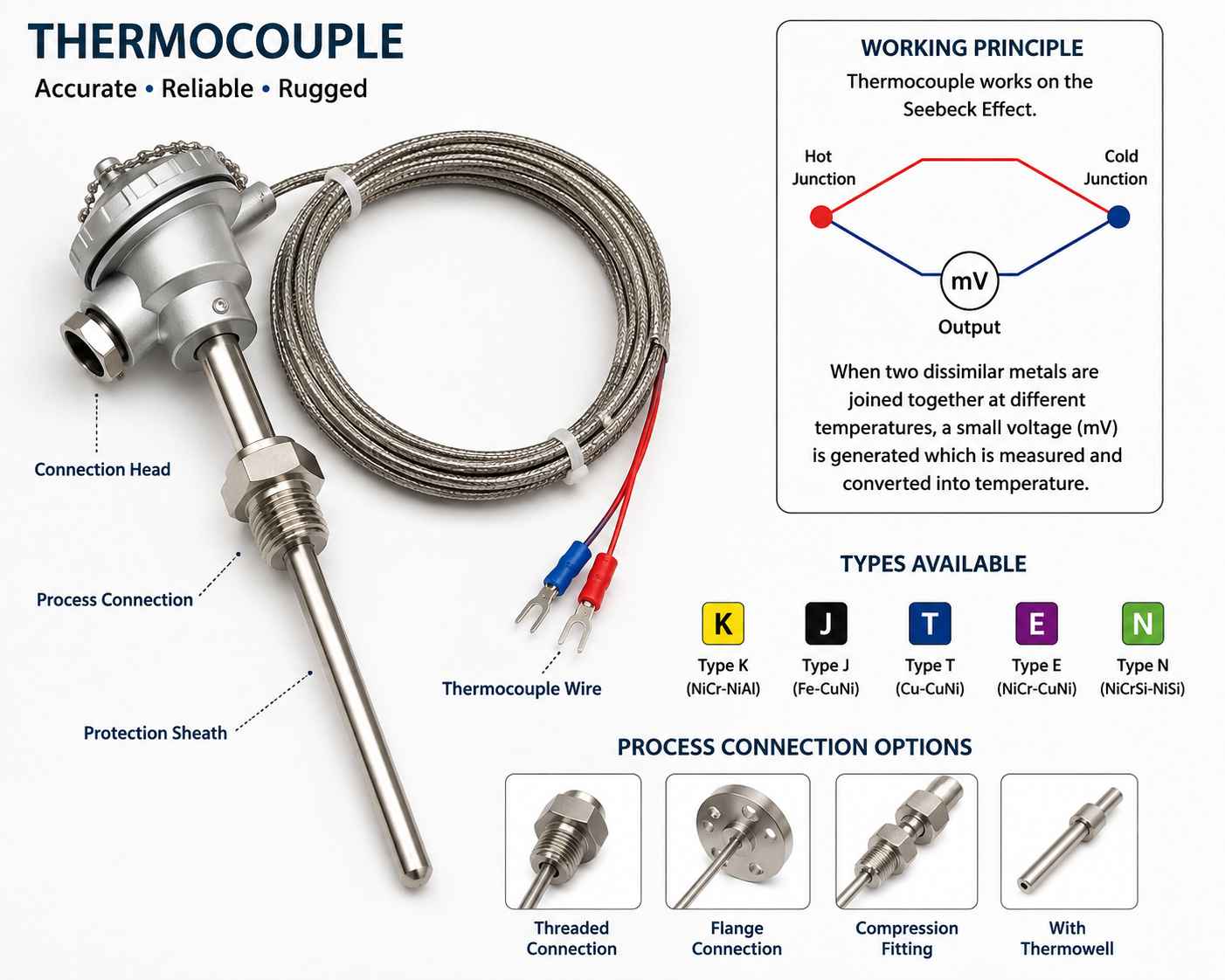
A Thermocouple is a reliable and widely used temperature sensing device designed for accurate measurement and monitoring of temperature across industrial and commercial applications. It operates on the Seebeck effect, where a small electrical voltage is generated when two dissimilar metal conductors are joined and exposed to a temperature difference.
Thermocouples are available in different types, materials, sheath configurations, and temperature ranges to suit specific process requirements. Common types include Type K, Type J, Type T, Type E, Type N, Type R, Type S, and Type B. Each type offers different temperature capabilities, sensitivity, and suitability for particular industrial environments.
The sensor can be supplied with different mounting and process connection options such as threaded fittings, flanges, compression fittings, or thermowells, allowing easy installation in pipelines, tanks, furnaces, ovens, boilers, and process equipment.
Key Features
- Accurate and reliable temperature measurement
- Fast response to temperature changes
- Wide operating temperature range
- Simple and rugged construction
- Available in multiple thermocouple types
- Different sheath materials available
- Suitable for high-temperature applications
- Various process connection options
- Available with extension cables and connectors
- Compatible with temperature controllers and transmitters
- Low maintenance requirement
- Suitable for continuous industrial operation
Working Principle
A Thermocouple consists of two dissimilar metal wires joined together at one end, known as the measuring or hot junction. When the hot junction experiences a different temperature from the reference junction, a small thermoelectric voltage is generated.
This voltage changes according to the temperature difference and is measured by a temperature indicator, controller, transmitter, or other instrumentation system. The electronic device then converts the thermoelectric signal into a temperature reading.
The simple operating principle makes thermocouples highly durable and suitable for demanding temperature measurement applications.
Common Thermocouple Types
| Type | Typical Materials | Common Applications |
|---|---|---|
| Type K | Nickel-Chromium / Nickel-Aluminium | General industrial and high-temperature measurement |
| Type J | Iron / Constantan | Industrial equipment and machinery |
| Type T | Copper / Constantan | Low-temperature applications |
| Type E | Nickel-Chromium / Constantan | High sensitivity applications |
| Type N | Nickel-Chromium-Silicon / Nickel-Silicon | High-temperature industrial applications |
| Type R | Platinum-Rhodium / Platinum | High-temperature and laboratory applications |
| Type S | Platinum-Rhodium / Platinum | Furnace and high-temperature measurement |
| Type B | Platinum-Rhodium / Platinum-Rhodium | Very high-temperature applications |
Technical Specifications
| Parameter | Specification |
|---|---|
| Product Type | Thermocouple |
| Sensing Principle | Thermoelectric / Seebeck Effect |
| Thermocouple Type | K / J / T / E / N / R / S / B |
| Temperature Range | Type & Model Dependent |
| Probe Material | SS304 / SS316 / Inconel / Other Options |
| Probe Diameter | Model Dependent |
| Probe Length | Application Dependent |
| Junction Type | Grounded / Ungrounded / Exposed |
| Process Connection | Threaded / Flanged / Compression |
| Thermowell | Optional |
| Output | Millivolt / Transmitter Output |
| Cable | Compensating / Extension Cable |
| Head Type | Standard / Weatherproof / Industrial |
| Accuracy | Class / Model Dependent |
| Application | Industrial Temperature Measurement |
Applications
Thermocouples are widely used in:
- Industrial Furnaces
- Ovens and Heat Treatment Equipment
- Boilers
- Power Plants
- Chemical Processing
- Pharmaceutical Industries
- Food & Beverage Processing
- Oil & Gas Industries
- Plastic & Rubber Processing
- Injection Moulding Machines
- HVAC Systems
- Kilns
- Industrial Machinery
- Process Automation Systems
Advantages
Thermocouples offer a combination of wide temperature capability, fast response, rugged construction, and simple operation. They are particularly suitable for environments where temperatures can change rapidly or where the sensor must withstand vibration, heat, and demanding industrial conditions.
Different thermocouple types and sheath materials allow the sensor to be selected according to the required temperature range and process environment. A thermowell can also be used to provide additional protection to the sensing element in demanding process installations.
Installation & Operation
The Thermocouple should be installed at a location that provides good thermal contact with the process while avoiding unnecessary exposure to mechanical damage or excessive vibration. The appropriate thermocouple type, sheath material, probe length, junction configuration, and process connection should be selected according to the application.
For pressurized or corrosive processes, a suitable thermowell and compatible sheath material should be considered to protect the sensing element and facilitate maintenance.
Industries Served
Chemical | Pharmaceutical | Oil & Gas | Power Generation | Food & Beverage | Manufacturing | Plastics | Steel | HVAC | Process Automation
Product Note
Exact specifications such as temperature range, accuracy, probe diameter, sheath material, thermocouple type, insertion length, process connection, and junction configuration vary according to the selected model. Refer to the relevant product datasheet for final technical specifications.
Reviews
There are no reviews yet.