Description
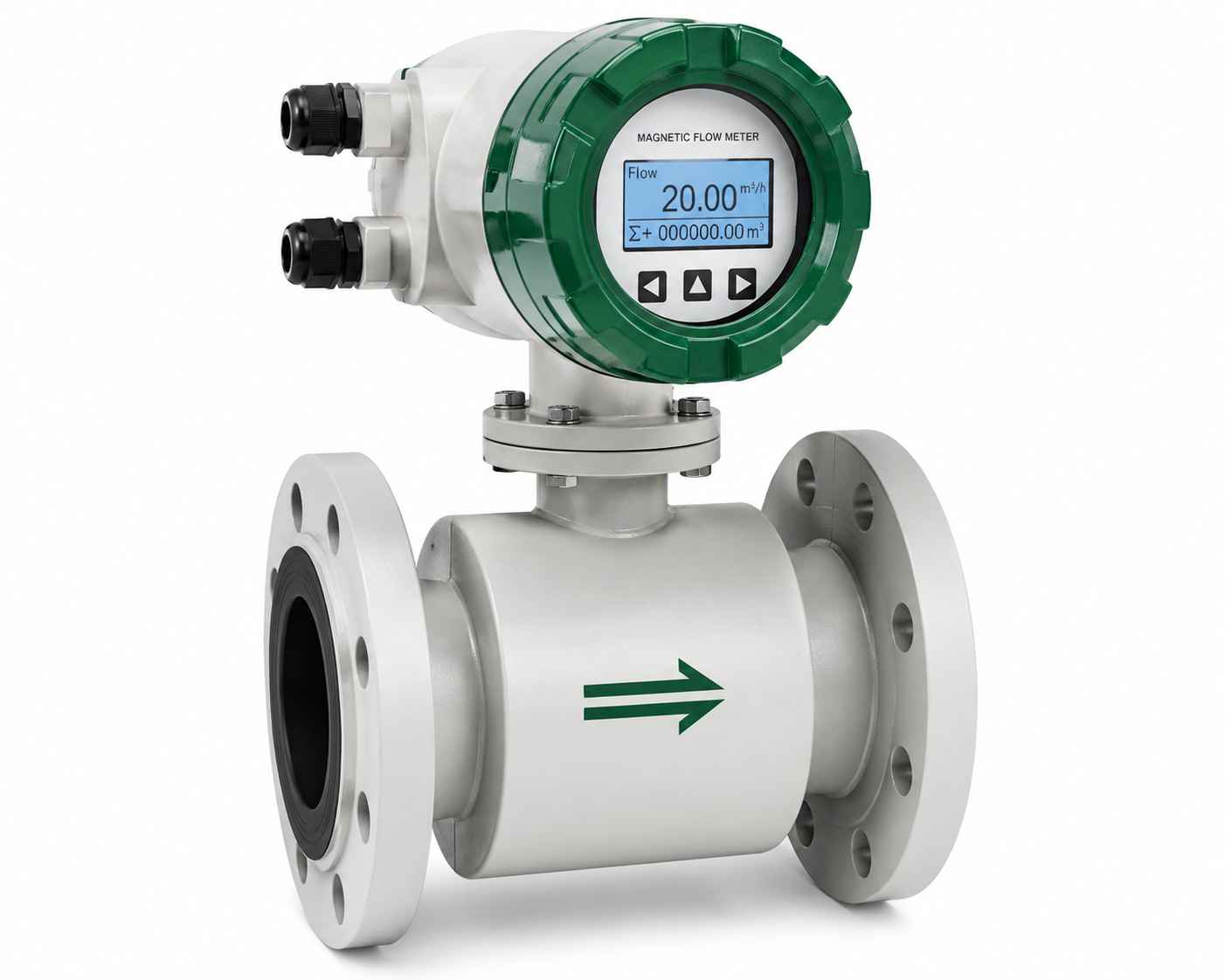
Magnetic Flow Meter
The Magnetic Flow Meter is a high-performance electromagnetic flow measurement instrument designed for accurate, reliable, and continuous measurement of electrically conductive liquids. It operates on the principle of Faraday’s Law of Electromagnetic Induction and provides precise flow measurement without any moving parts inside the measuring tube.
When conductive liquid passes through the magnetic field generated inside the flow tube, a voltage is induced across the electrodes. This voltage is proportional to the velocity of the liquid, allowing the transmitter to calculate and display the volumetric flow rate.
The absence of moving parts results in low maintenance, minimal pressure loss, long service life, and reliable operation. Different liner and electrode materials can be selected according to the characteristics of the process fluid, making the instrument suitable for water, chemicals, wastewater, and many other conductive liquids.
Key Features
- High accuracy and excellent repeatability
- Electromagnetic measuring principle
- No moving parts
- Minimal pressure loss
- Low maintenance requirement
- Continuous and stable flow measurement
- Digital LCD display
- Instantaneous flow and total flow indication
- 4–20 mA output available
- Pulse and digital communication options
- HART communication available on selected models
- Multiple liner and electrode materials
- Wide range of pipe sizes
- Robust industrial construction
- Suitable for demanding process environments
Working Principle
The Magnetic Flow Meter works according to Faraday’s Law of Electromagnetic Induction.
The flow tube generates a controlled magnetic field around the flowing liquid. When an electrically conductive liquid passes through this magnetic field, a small electrical voltage is generated between the measuring electrodes.
The induced voltage is directly proportional to the velocity of the liquid. The transmitter receives this signal, processes it electronically, and calculates the flow rate.
The measured value can then be displayed locally and transmitted to external control systems through standard industrial outputs.
Conductive Liquid → Magnetic Field → Electrode Signal → Signal Processing → Flow Measurement
Technical Specifications
| Parameter | Specification |
|---|---|
| Product Type | Magnetic / Electromagnetic Flow Meter |
| Measuring Principle | Faraday’s Law of Electromagnetic Induction |
| Medium | Electrically Conductive Liquids |
| Nominal Size | Model Dependent |
| Flow Range | Model Dependent |
| Accuracy | Model Dependent |
| Repeatability | Model Dependent |
| Liner Material | PTFE / Rubber / Other Options |
| Electrode Material | SS316 / Hastelloy / Other Options |
| Body Material | Carbon Steel / Stainless Steel / Model Dependent |
| Process Connection | Flanged / Wafer / Other Options |
| Display | Digital LCD |
| Output | 4–20 mA / Pulse |
| Communication | HART / Digital, Model Dependent |
| Power Supply | Model Dependent |
| Process Temperature | Model Dependent |
| Operating Pressure | Model Dependent |
| Protection Rating | Model Dependent |
| Installation | Inline Pipeline |
| Application | Conductive Liquid Flow Measurement |
Liner & Electrode Options
Different materials can be selected according to the process fluid and operating conditions.
Liner options:
- PTFE
- Rubber
- Other application-specific materials
Electrode options:
- Stainless Steel
- Hastelloy
- Other corrosion-resistant materials
Proper material selection helps ensure reliable operation when measuring corrosive, abrasive, or chemically aggressive liquids.
Applications
Magnetic Flow Meters are widely used in:
- Water & Wastewater Treatment
- Chemical Processing
- Pharmaceutical Industries
- Food & Beverage Industries
- Effluent Treatment Plants
- Power Generation
- Mining & Mineral Processing
- Pulp & Paper Industries
- Irrigation & Water Distribution
- Industrial Process Control
- Cooling Water Systems
- Slurry and Process Liquid Measurement
Advantages
The Magnetic Flow Meter provides accurate measurement without introducing moving mechanical components into the flow path. This significantly reduces mechanical wear and maintenance requirements.
Because the measuring tube has no obstruction from mechanical measuring elements, the meter produces very low pressure loss. This makes it suitable for continuous process applications where energy efficiency and reliable flow measurement are important.
The availability of different liner and electrode materials also allows the meter to be configured for different liquid characteristics and process conditions.
Installation & Operation
The Magnetic Flow Meter should be installed according to the manufacturer’s recommended piping arrangement and flow direction. Proper grounding is important for stable and accurate measurement.
The meter should be selected according to the pipe size, liquid conductivity, flow range, pressure, temperature, chemical compatibility, liner, and electrode material.
For optimum performance, the measuring tube should remain completely filled with liquid during normal operation, and the installation should minimize conditions that can introduce excessive turbulence or air into the measurement area.
Industries Served
Water Treatment | Wastewater | Chemical | Pharmaceutical | Food & Beverage | Power | Mining | Pulp & Paper | Manufacturing | Process Automation
Product Note
Exact specifications such as nominal size, flow range, accuracy, liner material, electrode material, pressure rating, temperature range, output, power supply, and communication protocol vary according to the selected Magnetic Flow Meter model. Refer to the relevant product datasheet for final technical specifications.
Reviews
There are no reviews yet.